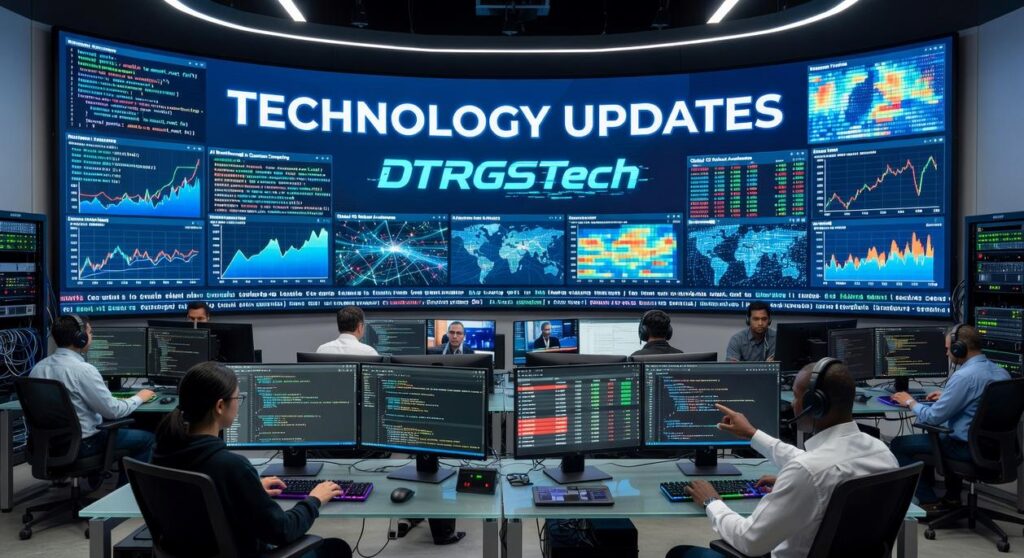
I track technology shifts every day because missing the right development can put you years behind.
You’re here because keeping up with tech feels impossible. New breakthroughs drop constantly and most coverage just adds to the confusion.
Here’s the reality: most tech news is noise. Only a handful of advancements actually matter for how you’ll work and live in the next few years.
I’ve filtered through the chaos to identify what’s real. dtrgstech focuses on separating genuine progress from hype, and that’s exactly what this guide does.
This article gives you a clear update on the tech developments you need to understand right now. I’ll cover AI, computing power, sustainable technology, and connectivity advances that are already changing things.
No fluff. No predictions about flying cars.
Just the advancements that are happening today and why they matter to you.
The AI Everywhere Revolution: From Novelty to Necessity
I was reviewing code with a developer last week when something caught me off guard.
He wasn’t Googling syntax anymore. He was having a conversation with his IDE about the best way to refactor a function. The AI suggested three approaches and explained the tradeoffs for each.
That’s when it hit me. We’re not playing with AI tools anymore. We’re working alongside them.
The shift from novelty to necessity happened faster than anyone expected.
A year ago, AI meant chatbots that gave you canned responses. Today? It’s woven into the software you use every day. Your design tool suggests layouts. Your coding environment catches bugs before you finish typing. Your project management system predicts bottlenecks.
This is the co-pilot era. And it’s changing how work gets done.
But here’s where it gets interesting.
AI doesn’t just read text anymore. The latest models process images, audio, and video all at once. I’m talking about systems that can watch a manufacturing line and spot defects human inspectors miss. Or analyze medical scans while cross-referencing patient history and current symptoms.
Multimodal AI is already in hospitals and factories. Not in five years. Right now.
Then there’s the privacy angle.
You know how everything used to get sent to the cloud for processing? That’s changing. Smaller AI models now run directly on your phone or IoT device (technology updates dtrgstech cover this shift in detail).
What does that mean for you?
Your data stays on your device. Response times drop to milliseconds instead of seconds. And you’re not dependent on an internet connection for AI features to work.
I tested this last month on a new smartphone. The voice assistant processed my request before I finished speaking. No lag. No upload. Just instant results.
That’s edge AI. And it’s rewriting the rules for personal tech.
The Next Wave of Computing: Power, Space, and Specialization
You’ve probably heard the buzz about spatial computing.
Most people think it’s just VR headsets for gaming. They’re missing the bigger picture.
I was talking to a manufacturing engineer last month. She told me something that stuck with me.
“We used to fly technicians across the country to train new workers on complex machinery. Now we put on a headset and walk them through it in real time.”
That’s spatial computing in action.
The hardware has gotten good enough that companies actually use it. Not for demos or marketing stunts. For real work that saves real money.
Remote teams are using AR overlays to collaborate on 3D designs. Surgeons are practicing procedures in virtual environments before they touch a patient. Data scientists are literally walking through their datasets instead of staring at spreadsheets.
Some people say this is all just expensive toys. That traditional screens work fine and always will.
But here’s what they don’t see.
When you’re trying to understand complex spatial relationships or train someone on a physical task, a flat screen doesn’t cut it. Your brain processes 3D information differently than 2D.
Now let’s talk about quantum computing.
I know. You’ve been hearing about quantum breakthroughs for years. Still waiting for your quantum laptop, right?
A researcher I spoke with at a materials lab put it bluntly: “We’re not replacing classical computers. We’re solving specific problems that would take classical systems thousands of years.”
Recent progress in error correction means quantum systems can run longer without falling apart. That matters for drug discovery where you need to simulate molecular interactions. Or for materials science where you’re trying to find new compounds with specific properties.
Is it going to change your life next year? No.
But companies working on battery technology and pharmaceutical development are already using quantum systems for targeted problems. The technology updates dtrgstech community has been tracking these applications closely.
Then there’s the chip story nobody’s talking about enough.
Specialized processors.
Your computer’s CPU is a generalist. It can do anything but isn’t optimized for anything specific. That worked fine until AI came along.
NPUs and TPUs are different. They’re built from the ground up to handle AI workloads. Matrix multiplication, tensor operations, the math that makes neural networks run.
The performance difference is wild. A task that takes minutes on a CPU can run in seconds on an NPU.
You’re already using these chips whether you know it or not. Your phone’s camera uses an NPU for computational photography. Data centers use TPUs to run the AI models you interact with daily.
And now they’re coming to personal computers in a big way.
This isn’t about faster email or web browsing. It’s about running AI models locally instead of sending everything to the cloud. Better privacy, faster response times, new applications we haven’t even thought of yet.
The next wave of computing isn’t one thing. It’s three parallel shifts happening at once.
Spatial interfaces that change how we interact with information. Quantum systems tackling problems classical computers can’t touch. Specialized chips making AI fast enough to be everywhere.
You don’t need to bet on all three. But you should know they’re coming.
Green Innovation: The Rise of Sustainable Technology
You’ve probably heard about electric vehicles getting better range.
But do you know what’s actually making that possible?
It’s not just bigger batteries. It’s a complete rethink of how we store energy.
Next-Generation Battery Technology
Lithium-ion batteries run most of our devices right now. Your phone, your laptop, maybe even your car. But they have limits.
They can catch fire. They lose capacity over time. And they’re expensive to scale.
Solid-state batteries change the game. Instead of liquid electrolytes (the stuff that can leak or burn), they use solid materials. This means they’re safer and can pack more energy into less space.
Some people argue we should just stick with lithium-ion and make incremental improvements. They say new battery tech is too expensive and years away from mass production.
Fair point. But here’s what that view misses.
Sodium-ion batteries are already here. Companies in China started producing them commercially in 2023. They use sodium instead of lithium, which is way more abundant and cheaper to source.
Sure, they don’t hold as much charge. But for grid storage? They work great. You don’t need to move a power plant around.
AI for Energy Efficiency
Here’s where things get interesting.
AI isn’t just for chatbots and image generators. It’s quietly (okay, not that quietly) reshaping how we use power.
Smart grids use machine learning to predict when you’ll need electricity. They balance supply from solar panels and wind farms in real time. Data centers are using AI to cut cooling costs by 30% or more, according to Google’s own reports.
The technology updates dtrgstech community has been tracking these developments closely. Industrial facilities are seeing similar results when they let AI manage their energy loads.
Circular Economy Tech
E-waste is piling up. We throw away 50 million tons of electronics every year.
Most of it just sits in landfills. The rare earth metals inside? Gone.
New recycling tech can extract those materials. Automated systems sort components faster than humans ever could. Chemical processes recover metals that used to be impossible to separate.
And biodegradable materials are moving beyond research labs. Some companies are making circuit boards that break down naturally. Others are developing phone cases from mushroom fibers.
It sounds weird until you see it work.
For more technical details on implementing these solutions, check out the developers guide dtrgstech.
Connectivity and Security in a Hyper-Connected World
You’ve probably heard the buzz about 6G.
But what does it actually mean?
Right now, 5G is still rolling out. Most people haven’t even experienced true 5G speeds yet. So why are we already talking about the next generation?
Here’s what’s different.
6G isn’t just about faster downloads. It’s about something called integrated sensing and communication. Think of it this way: your network won’t just transmit data anymore. It’ll sense the physical world around it.
Your autonomous car will use the same wireless signal to communicate AND detect obstacles. The network becomes both eyes and voice.
Industrial IoT Gets Smarter
The Internet of Things used to mean your fridge could tweet (which nobody asked for).
Now we’re seeing Industrial IoT take over factories and supply chains. These aren’t dumb sensors anymore. They’re intelligent edge devices that make decisions without waiting for the cloud.
A manufacturing robot can spot a defect and adjust its process in milliseconds. No round trip to a data center required.
This is where quality assurance dtrgstech becomes critical. When devices make autonomous decisions, you need rock-solid testing protocols.
The AI Security Problem
Here’s the uncomfortable truth about AI in cybersecurity.
Both sides have it now.
Attackers use AI to find vulnerabilities faster than any human could. They probe systems with machine learning algorithms that adapt in real time.
Defenders fight back with AI-driven threat detection that spots patterns humans would miss.
But there’s a twist. The AI models themselves need protection. I’m talking about adversarial attacks that trick neural networks into making catastrophic mistakes (like identifying malware as safe).
The technology updates dtrgstech community is watching show us this arms race is just getting started.
We’re not securing networks anymore. We’re securing the intelligence that secures the networks.
Staying Ahead in an Era of Constant Innovation
Technology moves fast.
You need to know what’s happening in AI, computing, sustainability, and connectivity. These aren’t separate trends anymore. They’re connected forces reshaping how we work and live.
I’ve watched companies fall behind because they couldn’t keep up with the pace of change. The landscape feels complex because it is.
But here’s the thing: understanding these core pillars gives you a map. You can see where things are heading instead of reacting after the fact.
You came here to get caught up on what matters. Now you have that foundation.
The real advantage isn’t just knowing about these advancements. It’s understanding how they solve actual problems. That’s where the opportunities are.
Stay engaged with dtrgstech for continuous updates on the trends that shape your future. The technology landscape won’t slow down, but you can stay ahead of it.
Your next step is simple: keep learning and watch for the signals that matter to your world.
 Founder & Chief Executive Officer (CEO)